
Watson Mere: The Forces
March 18, 2026 – April 1, 2026
Opening Reception: March 18, 6–8 pm
A Giant Amongst Monsters: A Conversation
Ritual, resistance, and the reclamation of power in Caribbean art
Tuesday, March 31, 2026, 6:30 p.m.
EFA Gallery
323 West 39th St., New York, NY, 3rd Floor
Hours: Tue–Fri, 12–5 pm
Curated by Jesse Bandler Firestone
EFA Gallery is pleased to present The Forces, a solo presentation of new work by EFA Studio Member Watson Mere.
The exhibition brings together a recent body of paintings devoted to the artist’s spiritual awakening in the context of Haitian Vodou and Americana. Developed following Mere’s recent residency at Haiti Cultural Exchange, the works that comprise The Forces depict visions, symbolism, and ritual motifs rooted in Yoruba religion (Ifá/Orisha) and West African Vodun, as well as Haitian Vodou. The paintings are built on highly textured surfaces composed of acrylic paint mixed with sugar, forming a thick, stucco-like ground that Mere manipulates into dimensional patterns reminiscent of flames, scorched earth, and rising heat. Fire appears throughout the works as image, process, memory and portal where tableaux of interdimensional and ancestral communing are revealed.
He is especially drawn to Ogou Chango, a syncretic lwa that bridges the Yoruba Orisha Ṣàngó with the Vodou lwa Ogou, linking traditions of thunder, iron, fire, war, and justice. For Mere, his affinity for Ṣàngó affirmed fire and strength not simply as a visual motif, but as an active spiritual presence in his life. While Ṣàngó is featured heavily in The Forces, one painting pays particular homage to Ezili Dantò, the lwa invoked during the Bwa Kayiman Vodou ceremony and as legend goes, sparked the Haitian revolution.
Though woven through folklore, the actual presence of fire in Mere’s life predates the residency and further underscores his relationship to Sàngó, Ezili Dantò, and the spirits of Petwo. In his hometown in South Florida, towering plumes of smoke routinely mark the landscape as sugarcane fields are burned to clear space for new growth. His parents worked in the local cane fields, and as a child, Mere came to understand that many enslaved West Africans were brought to Hispaniola during the transatlantic slave trade and forced to labor on sugar plantations under French and Spanish rule. Over time, this realization formed a powerful link: he was witnessing his parents work in conditions structurally, visually, and environmentally similar to those endured by his ancestors centuries earlier.
With this history as further fuel, Mere also deliberately pushes against familiar tropes of Black figuration and legibility. Rather than centering the body as the primary site of representation, the paintings center symbolism, ritual codes, and material signs. Figures are implied rather than fully depicted; meaning accrues through gesture, texture, and accumulated reference. Fire, flags, totems, and votive forms operate as signifiers that refuse easy readability, shifting the viewer’s attention towards recognition of spiritual symbols and metaphysics.
In this way, Mere’s paintings assert opacity as a form of agency. They propose an aesthetic rooted not in exposure or spectacle, but in spiritual presence, inheritance, and refusal—where symbolism takes precedence over direct representation, and meaning circulates equally through what is both withheld and gleaned.
Jesse Bandler Firestone is a curator, producer, and writer dedicated to supporting artists across disciplines and bringing audiences closer to the creative process. With over a decade of experience, he has held curatorial roles at Montclair State University, Wave Hill, The Shed, and Residency Unlimited, where he has developed exhibitions and programs centered on conceptual art, queer practice, institutional critique, and experimental approaches to site and community.
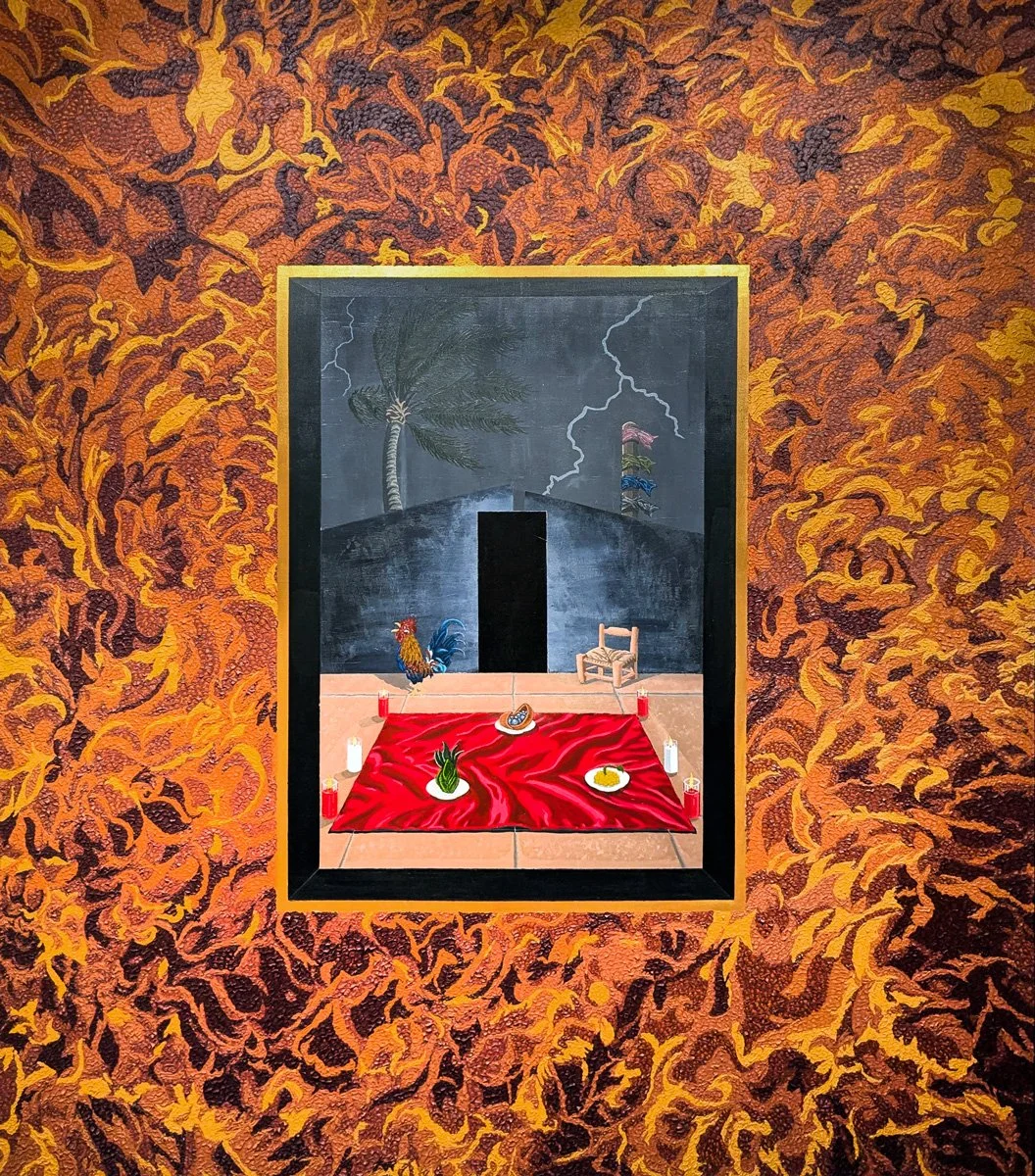
Watson Mere, Lafimen, 2026
EXHIBITION MATERIALS
SPECIAL PROGRAMMING
A Giant Amongst Monsters: A Conversation
Tuesday, March 31, 2026, 6:30 p.m.