
Post Seduction
September 15 – December 8, 2026
Opening Reception: September 15, 6:30–8 pm
Sally Apfelbaum
Dietmar Busse
Katya Grokhovsky
Rie Hasegawa
Calvin Kim
Cary Leibowitz
Regina Parra
Charlie Perez-Tlatenchi
Armita Raafat
Dena Sturm
Curated by Deric Carner
Let me stop right here. Let me pretend this is actually
what I am seeing (I really did see it, when I first stopped)
and not, here too, more fantasies of mine,
more of those memories, those voluptuous illusions.
C.P. Cavafy
EFA Gallery is pleased to present a selection of works that unfold under the rubric of post-seduction, suggesting a value system that integrates disquiet and disorder alongside attraction. There are many registers at play, ranging from the confrontational to the poetic, often lingering in states of aftermath or longing. The works on view toy with the idea of seduction, at times pulling you in and at times challenging expectations of fulfillment.
In a period marked by profound social and political unease, to paraphrase Cary Leibovitz (aka Candy Ass), the state of art should reflect that. Abrasion and ugliness have long held an important place in the culture of countercultures, but lately have felt ubiquitous in response to an environment of deepening sociopolitical repulsion. From the Whitney, along the High Line, to the studios of EFA and beyond, ugly is in. But of course, it’s not that simple. What feels rough or abrasive one era can become canonical the next. What initially appears grotesque may ultimately reveal an uncomfortable truth.
It is possible to embrace the experience of seduction while remaining aware of its capacity to deceive. The awkwardly charming paintings of Sally Apfelbaum, one of which provided this show’s title, are not bitter in their campiness. Apfelbaum explores subjects often associated with teenage male fantasy, approaching them with a playful self-awareness evident in her small panels. Her practice extends this sense of humor and reclamation into her engagement as a community organizer and advocate for under-resourced immigrant communities, framing her spy narratives as acts of joyful recuperation.
To view art with generosity is to open oneself to seduction and the hard feelings that might follow. Dena Sturm’s flowers are unmistakably wilted, yet two empty vases suggest the possibility of renewal. The work remains suspended between optimism and ambiguity, inviting the viewer to consider whether the promise of what is to come offers consolation or simply deepens ambiguity. Regina Parra’s painting also traffics in loaded metaphors, here presenting a limp arm floating in a bath of partially opened fruit and milky opacity. The ambiguous scene suggests that something has occurred, leaving the viewer to consider whether an aftermath signals loss, transformation, or renewal.
Charlie Perez-Tlatenchi’s lenticular print brings together Catholic saint cards, fragments of advertising imagery, and photographs from a diasporic homeland, creating an elusive constellation of cultural memory and devotion. Its tropical hues and reflective surfaces draw the viewer in, while its fragmentation and visual instability simultaneously create distance.
The embroidered textiles that Armita Raafat has incorporated into her handmade paper work since 2021 are created in collaboration with artisans on Qeshm Island in the Strait of Hormuz. This origin lends the materials a heightened sense of history and anxiety. Raafat’s work balances the sublime with an undercurrent of intrigue, leaving the viewer uncertain whether they are encountering a formal abstraction or something more powerful.
If seduction is defined by heightened responsiveness to stimulus, its opposite may not be repulsion, but composure in the face of turbulence and temptation. Calvin Kim’s paintings embody this sense of dreamtime calm, presenting vignettes that invite contemplation of a world askew. The polaroids of Dietmar Busse are an equally cool delight. They are created simply, with flower petals and body paint. The result is magical. There is a deep longing in them that is poignant without being sentimental.
Katya Grokhovsky creates performances, installations, paintings, and videos, often employing unruly personas to interrogate the social expectations imposed upon individuals. Characters such as Bad Woman deliberately subvert the conventional ideas of the “good woman” as docile, attractive, petite, and accommodating. Through this exaggerated persona, Grokhovsky examines the exhaustion, discomfort, and failure inherent in performing socially prescribed roles within an increasingly disordered world.
Rie Hasegawa’s recurring depictions of piles of babies emerge from a pareidolic, automatic drawing practice in which figures gradually materialize from indeterminate grounds. The resulting forms evoke both physical entanglement and psychological weight. Although Hasegawa does not have children, these drawings are haunted by an uncanny vision of post-coital anxiety, transforming the familiar imagery of infancy into something psychologically charged and unsettling.
When speaking about art, it is difficult to avoid metaphor. Cary Leibovitz’s Fuck Metaphor, a text applied to the silhouette of a poodle, offers a queer-coded rejection of precisely this impulse. The work’s blunt declaration resists the interpretive machinery that so often surrounds contemporary art, insisting instead on the immediacy of the object, the text, and the viewer’s response.
EFA Gallery is the exhibition space of The Elizabeth Foundation for the Arts, dedicated to supporting artists at all stages of their practice and to presenting work that reflects the social, material, and political conditions shaping contemporary life. Rooted in EFA’s longstanding commitment to artists, experimentation and cultural sustainability, EFA Gallery serves as a platform for dialogue between artistic production, public engagement and the evolving role of artists within the city.
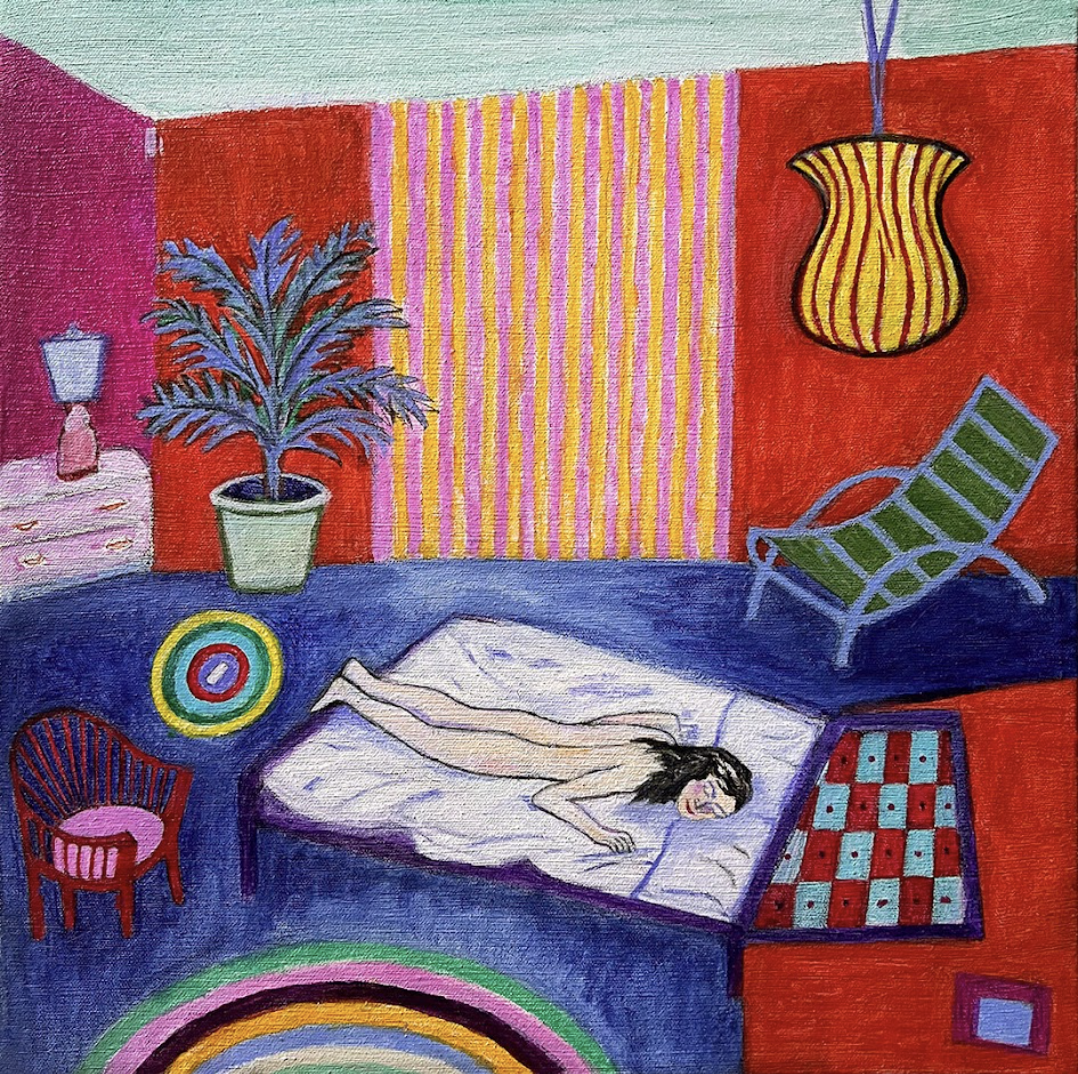
Sally Apfelbaum, After Sex with a Spy, 2025